
-
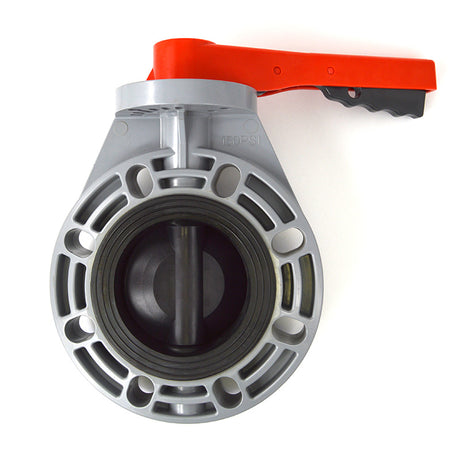
6" CPVC Butterfly Valve (SK-CBF-060) - EPDM / Lever Handle
Low stock$1,102.87Unit price /Unavailable -
-
4" CPVC Butterfly Valve (SK-CBF-040) - EPDM / Lever Handle
Low stock$687.56Unit price /Unavailable -
-
3" CPVC Butterfly Valve (SK-CBF-030) - EPDM / Lever Handle
Very low stock$390.62Unit price /Unavailable -
-
8" CPVC Butterfly Valve (SK-CBF-080) - EPDM / Lever Handle
Very low stock$905.65Unit price /Unavailable -


Why Choose CPVC Over PVC Butterfly Valves
Both PVC and CPVC butterfly valves offer corrosion resistance, lightweight construction, and easy installation. The key difference is temperature tolerance. PVC maxes out at 140°F and is well suited for cold water, irrigation, and general-purpose flow control. CPVC handles temperatures up to 200°F without losing structural integrity, which makes it the preferred material for hot water distribution, chemical feed systems, heated process lines, and industrial applications where fluid temperatures exceed what PVC can safely manage.
If your system runs at or near ambient temperature, a PVC butterfly valve will do the job at a lower cost. If hot fluids or elevated operating temperatures are involved, CPVC is the safer and more durable option.
How CPVC Butterfly Valves Work
A butterfly valve uses a disc mounted on a rotating stem to control flow. Turning the lever handle rotates the disc 90 degrees. When fully open, the disc sits parallel to the flow path and allows near-full throughput. When closed, the disc turns perpendicular to the pipe and seals against the EPDM liner for a bubble-tight shutoff. Partial positions between open and closed allow you to throttle or regulate flow, which is one of the primary advantages butterfly valves have over ball valves.
Because the disc remains in the flow path even when open, butterfly valves do create a small pressure drop compared to full-bore valve types. For most applications this is negligible, but it's worth considering in systems where maintaining maximum flow velocity is critical.
Common Applications
- Chemical processing and dosing: CPVC resists a wide range of acids, bases, and corrosive chemicals. The higher temperature rating allows use in heated chemical feed lines and mixing systems.
- Hot water distribution: Commercial and industrial hot water supply lines where PVC would soften or fail over time.
- Wastewater treatment: On/off and throttling control in treatment plants, clarifiers, and filtration systems handling warm effluent.
- Food and pharmaceutical processing: Sanitary liquid handling where corrosion-resistant, non-metallic valves are preferred.
- Pool and spa systems: Flow control for heated pool water, spa plumbing, and backwash lines where water temperatures exceed PVC's safe operating range.
Specifications
- Body Material: CPVC
- Disc Material: CPVC
- Seal/Liner: EPDM
- Stem: 304 Stainless Steel
- Operator: Lever handle
- Style: Wafer
- Pressure Rating: 150 PSI at 73°F
- Max Operating Temperature: 200°F
- Sizes Available: 3", 4", 6", 8"
- Connection: Flange (bolt hole pattern)
Installation Notes
CPVC butterfly valves install between two flanges using a wafer-style mounting. Position the valve between the flanges, align the bolt holes, and tighten the bolts evenly in a star pattern to ensure uniform compression on the EPDM seal. Do not over-torque the flange bolts, as this can distort the valve body or damage the liner. Leave enough clearance around the lever handle for a full 90-degree swing. For larger sizes or systems that require frequent operation, consider a gear-operated valve for easier actuation.
Always derate the pressure rating when operating at elevated temperatures. The 150 PSI rating applies at 73°F and decreases as fluid temperature rises toward the 200°F maximum.
Looking for help selecting the right CPVC butterfly valve for your system? Contact our team or request a quote for project pricing.